Check the readiness components, standard attribution, clause coverage, stale-evidence discount and score bands.
Product location: /qms/audits. Select Dashboard. Scroll to Certification Readiness.
Open Audit & Inspection → Dashboard → Certification Readiness. Each subscribed standard has its own card. The standard workspace restricts the card to its selected standard. Reporting requires Manage audits permission.
The card shows the standard, tracked certification status, optional target date, overall score, readiness band, four component scores and supporting counts. The tracked certification status and target date are contextual records; they are not calculated from the readiness score.
Ready and Almost ready are internal reporting labels. They do not grant certification or establish that an external auditor will accept the evidence. Review coverage, findings and evidence together with the score.
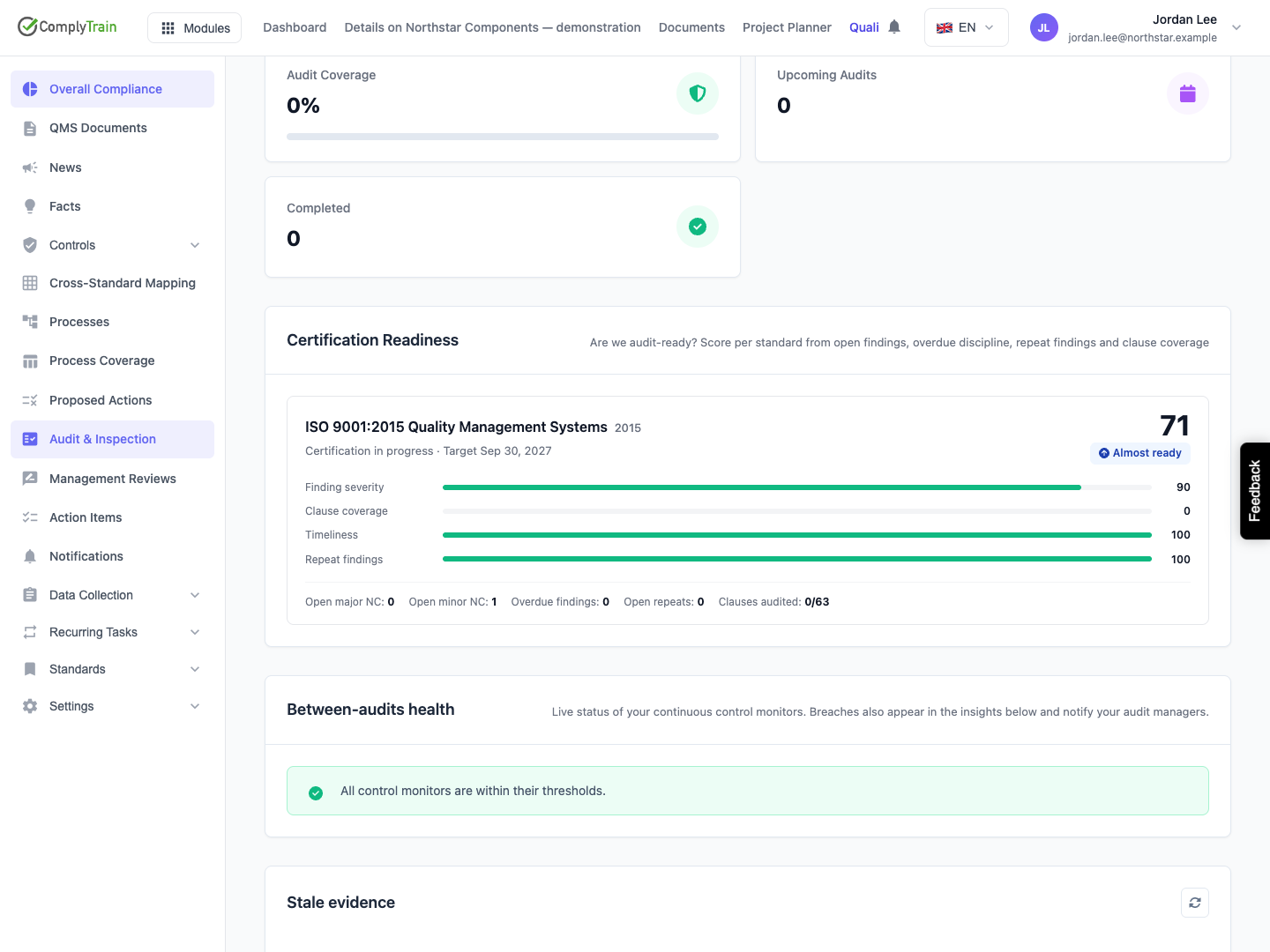
Product location: /qms/audits. Select Dashboard. Scroll to Certification Readiness.
Each component is between 0 and 100; a higher score contributes more to overall readiness.
Displayed component | Calculation | Weight when clause coverage is available |
|---|---|---|
Finding severity | Start at 100; subtract 25 per open major NC, 10 per open minor NC and 2 per open observation; stop at 0. | 40% |
Clause coverage | Audited in-scope clauses ÷ all in-scope clauses × 100, rounded to a whole number. | 25% |
Timeliness | Start at 100; subtract 20 per overdue finding; stop at 0. | 20% |
Repeat findings | Start at 100; subtract 25 per open repeat finding; stop at 0. | 15% |
Here, open means any state other than Closed or Accepted. An open draft with a classification can therefore affect the score. Positive findings and opportunities do not reduce the severity component, but a finding's overdue or repeat flags can still affect the other components.
For readiness, an open finding is overdue if its closure due date is before today, or its response due date is before today while it is Response required. A finding satisfying both conditions counts once. This differs from the headline Overdue Findings card, which only checks closure deadlines.
Product location: /qms/audits. Select Dashboard. Scroll to Certification Readiness.
A finding with explicit clause mappings contributes to the mapped standards. Multiple mapped clauses within one standard count the finding once for that standard's readiness inputs.
If it has no clause mappings at all, the finding contributes to every standard covered by its engagement. Once at least one mapping exists, the fallback no longer applies to the engagement's other standards. A finding with neither mappings nor an engagement standard cannot contribute to a particular standard's score.
This attribution differs from the standard-filtered Finding Trends chart, which uses the engagement's standards. Reconcile the finding's mappings and engagement scope when those views differ.
Product location: /qms/audits. Select Dashboard. Scroll to Certification Readiness.
The denominator contains distinct, active, In scope requirement clause references for the standard. Duplicate requirements for the same clause do not multiply its denominator. Requirements without a clause reference are excluded.
A clause in that denominator counts as audited when it appears in a Completed checklist's clause references or in an explicit finding-to-clause mapping. Merely planning a checklist does not qualify. Mapping a finding is sufficient for this reporting measure; it does not imply the finding is closed or the clause is conforming. Audited clauses outside the denominator do not increase the percentage, and the calculation has no audit-recency window.
If there are no in-scope clauses, coverage is unavailable rather than a demonstrated 100%. The other weights are redistributed proportionally: the weighted sum of severity, timeliness and repeat scores is divided by 0.75. With no findings, no in-scope clauses and no stale evidence, that can produce a score of 100 despite no demonstrated audit coverage.
Product location: /qms/audits. Select Dashboard. Scroll to Certification Readiness.
After combining the available components, the service applies an additional freshness factor:
Freshness factor = max(0, 100 − 15 × stale evidence count) ÷ 100.
Overall score = round(weighted component score × freshness factor).
One stale evidence record multiplies the base score by 0.85; two multiply it by 0.70. Seven or more reduce this factor to zero. Stale means Valid until is in the past. This check does not impose an age limit on evidence without an expiry.
Finding-linked stale evidence follows its finding's clause-standard attribution, with engagement-standard fallback when there are no mappings. Evidence without a linked finding contributes to every standard covered by its engagement. Each evidence record counts once per attributed standard.
In this release the dashboard response and card omit the freshness score and stale-evidence count, even though the service applies them. The overall score can therefore be lower than the weighted average of the four visible meters. Inspect Stale evidence on the tenant-wide audit dashboard and the underlying engagement evidence. Its five-row shortlist is not an exhaustive count for the standard.
Product location: /qms/audits. Select Dashboard. Scroll to Certification Readiness.
The example has one open minor NC, no open major NC, no overdue or repeat findings, and zero audited clauses out of 63 in scope. There is no stale evidence.
Component | Score | Weighted contribution |
|---|---|---|
Finding severity | 90 | 36 |
Clause coverage | 0 | 0 |
Timeliness | 100 | 20 |
Repeat findings | 100 | 15 |
Total before freshness | — | 71 |
With a freshness factor of 1, the overall score is 71 — Almost ready. The low clause coverage remains a material gap despite that label. If one stale evidence record were attributed to the same standard, the same base score would become round(71 × 0.85) = 60. That second calculation is an illustration of the formula, not a captured product outcome.
Product location: /qms/audits. Select Dashboard. Scroll to Certification Readiness.
Overall score | Displayed band |
|---|---|
85–100 | Ready |
70–84 | Almost ready |
50–69 | Needs work |
0–49 | Not ready |
The band comes from the rounded overall score. A change to findings, deadlines, mappings, requirement scope or evidence expiry can change it. A target certification date passing does not directly alter the calculation.
Product location: /qms/audits. Select Dashboard. Scroll to Certification Readiness.
Check the selected standard and its requirement scope first. Then review open findings, their classifications and mappings, response and closure dates, and repeat links. Inspect expired evidence and completed checklist coverage before treating a high or low score as a meaningful change.
Use Findings for finding follow-up and Audits for engagement checklists and evidence. Correct source records only when the change is justified, save them, then reload the dashboard. There is no manual score override or readiness approval control on this card. A screenshot of the score is not a substitute for the underlying audit records.
